Haniff Hoosen
Flood-Proofing
A City
Over the last 40 years, the city of Durban has experienced an increasing frequency and intensity of severe weather patterns and flooding. Damages amounting to billions of rands have been seen throughout the city with hundreds of lives lost.
This article provides an assessment of historical flood incidents and covers the following topics:
- An assessment of the frequency of flooding incidents.
- The impact of flooding on jobs, damage to infrastructure and loss of life.
- Factors that contributed to the damage and loss of life.
- Budget and expenditure patterns.
- Factors that should be considered to mitigate against damage and the loss of life.
On the 11th of April 2022, the residents of Durban experienced rainfall and flooding like never seen before in more than 200 years.
What was initially thought would be just another normal storm, turned out to be a catastrophic disaster affecting thousands of residents and causing billions of rands worth of damage to private and public infrastructure.
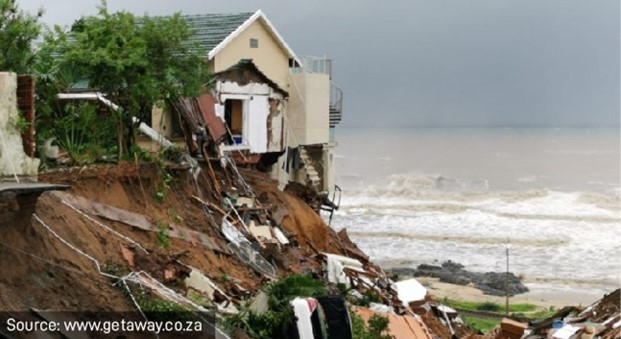
Source: getaway.co.za
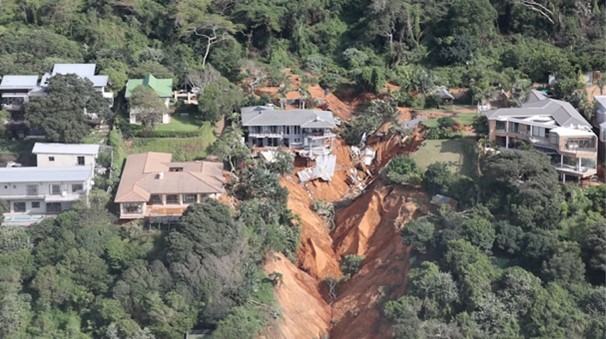
Source: IOL
So severe was the devastation, that in May of the same year, Parliament established an ad hoc committee to assess the impact of the damage. The committee also conducted oversight of the municipalities’ rapid interventions towards rebuilding and supporting local communities.
Extent and Impact of the Floods in April 2022 - Durban
Durban and surrounding areas were grappling with the devastating effects of severe flooding. On the 19th of April 2022, President Cyril Ramaphosa declared a state of emergency. Informal settlements were hardest hit, displacing thousands of families and forcing many into temporary shelters. The disaster exposed deep vulnerabilities in housing and infrastructure, as the city struggled to cope with the scale of destruction and human suffering.
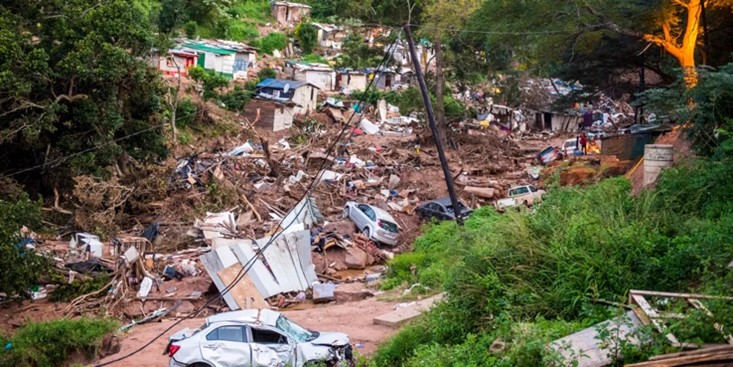
Source: Sky News Online
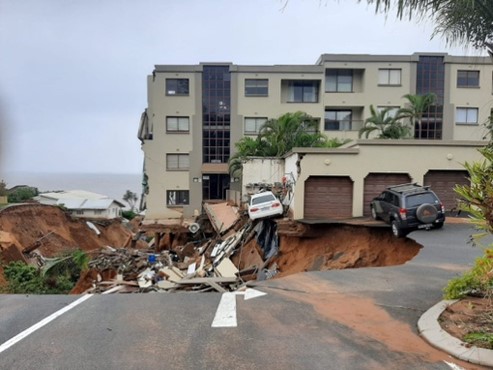
Source: Daily News
13500
Homes Destroyed
6000
Families Relocated
435
Fatalities
100
Transit Camps Established
54
People Missing
1152
Businesses Affected
Cost Implications
Whilst the KZN Provincial Government reported damages to infrastructure in the entire Province to be in the region of R17bn, the eThekwini Municipality reported total damages to public infrastructure estimated in the region of R1.4bn. Business Partners estimated that the total direct and indirect loss to the economy amounted to around R75bn.
One of the hardest hit industrial areas was located in the South of Durban, more commonly known as the South Industrial basin. It is an area that is largely industrial and accounts for about 20 000 jobs in the area and contributes about R3bn per annum in revenue to the city. Other major employers in the South Durban Basin like SAPPI, MONDI and SAPREF were also affected and suffered substantive damages to their plants.
Source: The Citizen
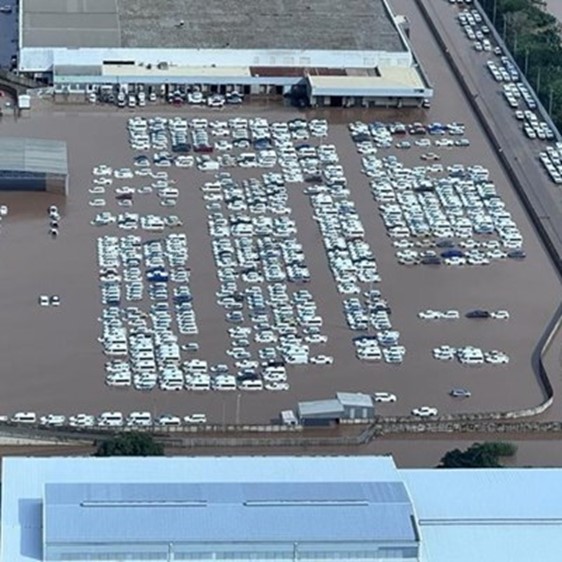
Amongst the hardest hit was the well-known Toyota Plant in Prospecton (pictures above and below). The entire plant was submerged under water and thousands of vehicles were permanently damaged. 88% of the ready-to-ship vehicles were totally destroyed and the plant was shut down for 3 months for repair work to begin. To prevent future damages during flooding, Toyota invested R236m in critical flood prevention infrastructure around their plant.
Source: The Citizen
Source: The Citizen
Business Tech recently reported that the insurers of Toyota (Tokio Marine) are now suing the eThekwini municipality for R6.5bn for damages and losses incurred. A river canal built several years ago by the Municipality, designed to redirect the Umlaas River away from the Prospecton area, was not properly maintained. This caused a catastrophic failure of the canal and the raging flood waters from the Umlaas river overflowed into the industrial area. As a consequence of this service delivery failure, the city is now in a legal battle with Toyota SA, the outcome of which could impact on the financial stability of the municipality and future service delivery levels.
Historical Trends
Climate change is a global phenomenon and throughout the world we are seeing an increase in floods and rising sea levels. Durban is no exception to this and the potential impacts of climate change on the city is well known for a long time. However, instead of adapting to climate change patterns and implementing proactive/preventative measures to mitigate against the impacts of climate change, the city’s leadership has often adopted a reactive approach and uses climate change as the convenient excuse.
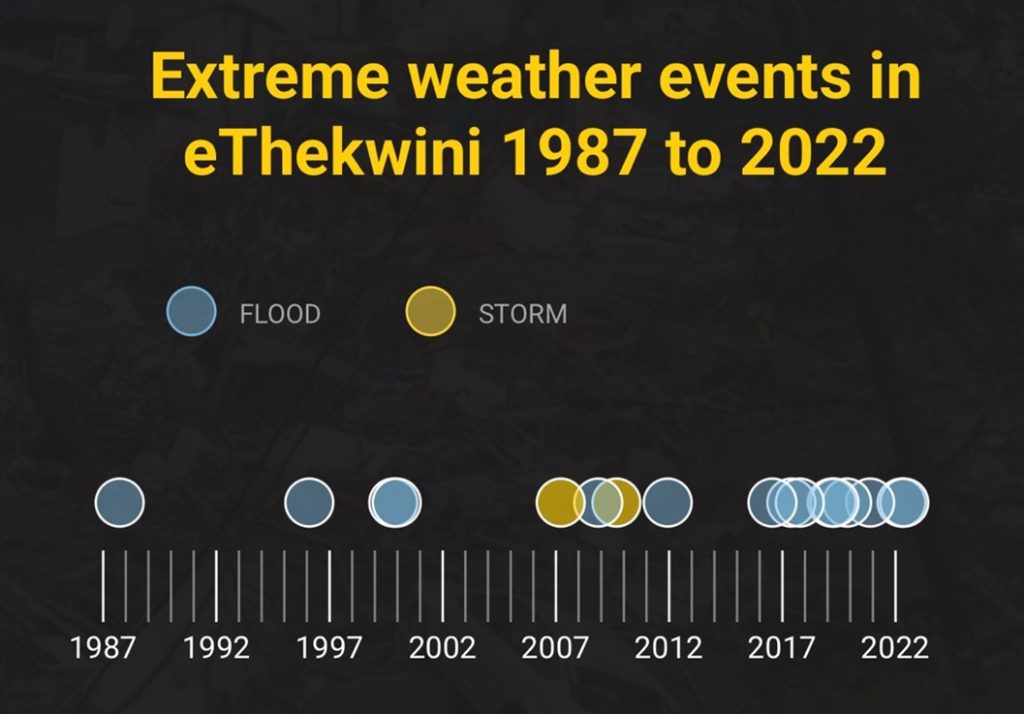
The figure below indicates the frequent nature of severe storm and flood events in the city over the last 35 years.
Source: The Perfect Storm
During the month of March 2025, Durban once again experienced disruptive rain and flooding. Fortunately on this occasion, the damages were not as severe as the April 2022 floods which were a historic event.
In a flood prone city like Durban, climate change adaptation policies are critical for the future development and sustainability of the city.
This view is also expressed by climate change expert Professor Tafadzwa Mabhaudhi, from the London School of Hygiene and Tropical Medicine when he wrote recently:

Major Contributing Factors
While it is generally accepted that the effects of climate change will contribute to unusual rainfall patterns and that the propensity for flooding will increase, a responsible city government will adapt its policies, procedures and response strategies to ensure the minimal amount of damage and loss of lives. The failure to act accordingly will have long term consequences on the city’s finances and its ability to develop according to its developmental plans.
One such example is the failure to recognise the importance of managing land use development in flood plains.
The figure below illustrates the geographical location of informal settlements, in relation to natural rivers and streams in the city. The yellow lines depict rivers and streams and the red shaded areas indicate the location of informal settlements.
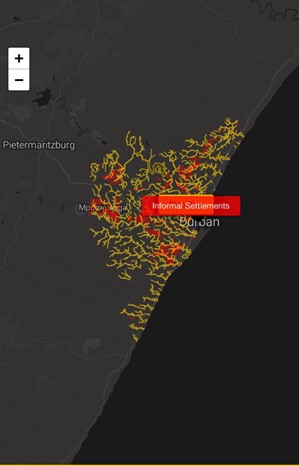
In his recent address during the budget hearings, the Mayor of eThekwini reported that Durban has the largest number of informal settlements in the country with a total of 580 informal settlements accommodating approx. 314 000 households. Land invasion prevention strategies are ineffective in the city with an average of 4000 new informal dwellings being constructed around the city every year. Most of these informal settlements are located either on the banks of rivers and streams or in flood prone areas. At the current development levels, it will take the municipality more than 90 years to provide formal housing for these settlements.
On each occasion of heavy flooding, the city has to take emergency steps to relocate and accommodate thousands of residents at huge cost to city finances. This reactive approach has cost the city billions of rands and the failure to address these historical land use spatial patterns continue to burden the city’s budget.
Development on Flood Plains
For many years the municipality has failed to respect the importance of enforcing its bylaws on flood plains. There are international norms and standards for developments on flood plains and the eThekwini Municipality, through its town planning department, has not enforced these by-laws sufficiently. Figure 3.1 below show an example of one such flood plain with the 100 year flood line clearly depicted in yellow shading. Figure 3.2 depicts an aerial view of the developments in this area, showing clearly the lack of enforcement of the 100 year flood line. The red shaded areas in fig 3 indicates property damage experienced in the 2022 floods.
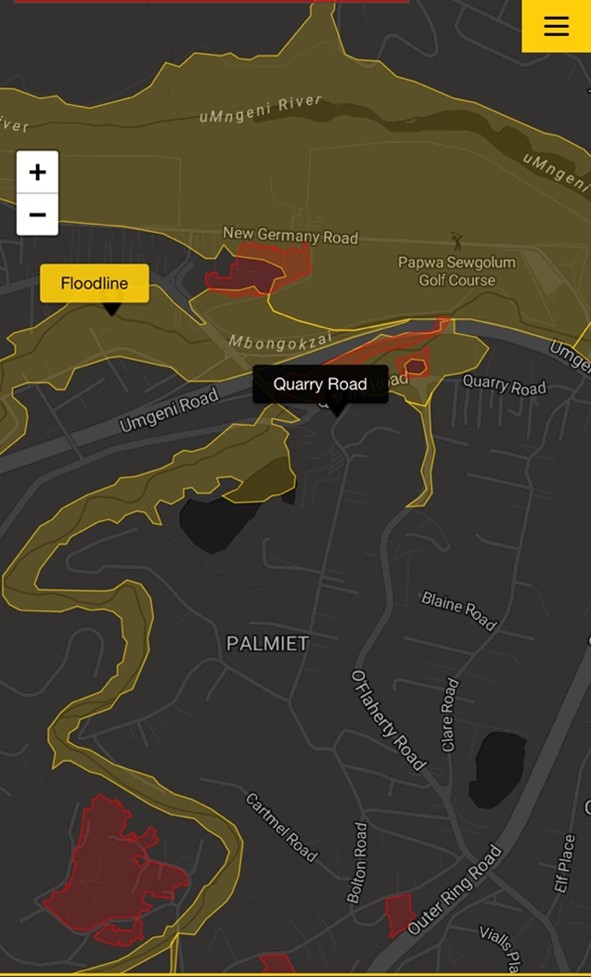
Figure 3.1 – Source: The Outlier
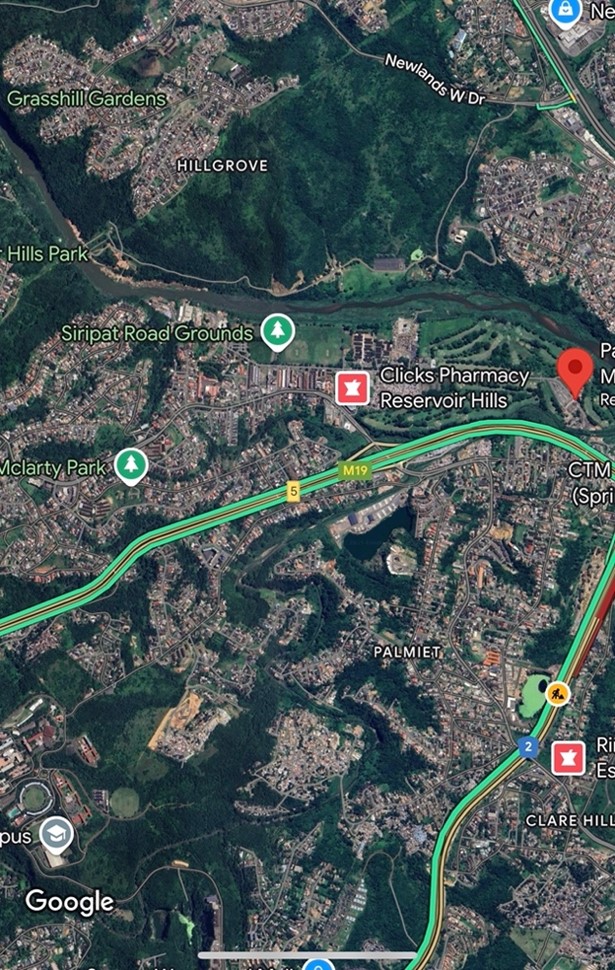
Figure 3.2 – Source: Google Maps
This is just one example of the city’s failure to strictly enforce development by laws in the city. In addition to this the city has been grappling with service delivery failures and maintenance of its storm water systems. Unlike the City of Cape Town that embarks on a city-wide drain cleaning campaign in preparation for winter high rainfall patterns, the eThekwini municipality adopts a more reactive approach and sends out drain clearing teams after the rains have occurred. It is the reason why many of the city’s roads come to a standstill during periods of heavy rainfall.
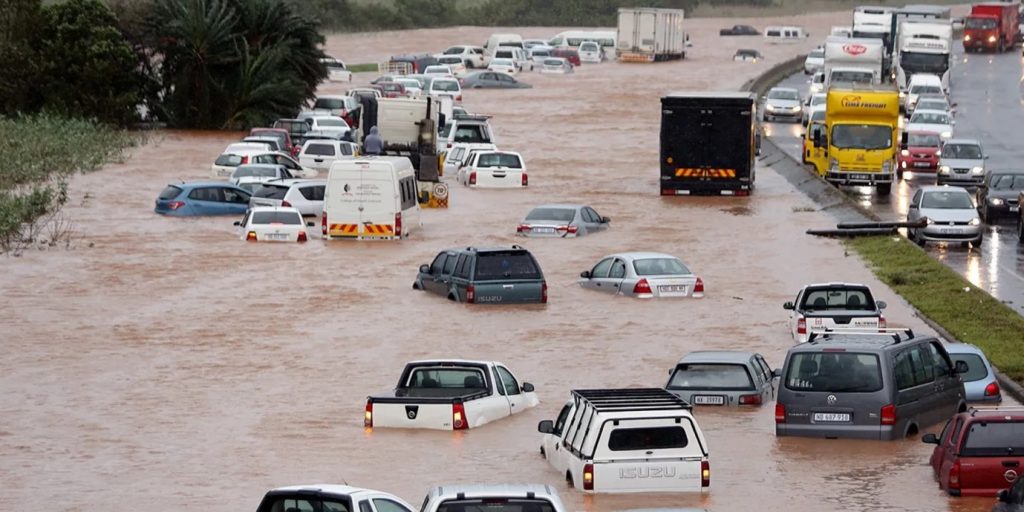
Source: IOL
Ineffective Early Warning Systems
During the April 2022 floods, more than 400 people lost their lives. Many of these unfortunate souls were living in informal settlements, many of which are located adjacent to rivers and streams. Some of the missing persons who were swept away in the floods, were unaware that water levels were rising and late into the night, while many families were asleep, the adjacent river burst its banks and washed scores of homes away.
While the city has invested in early warning weather systems in partnership with SA weather service, the implementation and communication of warnings were insufficient.
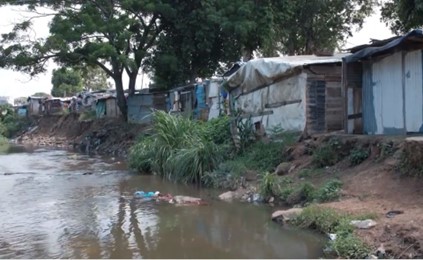
Source: African Mirror
One community leader, Nomandla Nqanula from the Quarry Road informal settlement recalled the night of the floods, to a local publication. In it she describes that had it not been for the local community who sent out WhatsApp messages to friends and neighbours in the settlement, the number of deaths would have been much higher.
Maintenance of Rivers and Streams
Heavy rainfall brings an increase amount of surface run-off into streams and rivers causing heavier flows downstream. In the process, it destroys and carries with it debris and overgrown verges along the banks of the river. This debris poses a huge risk to communities living downstream when nearby bridges and culverts become blocked. This accumulates and forms makeshift dams which eventually bursts and wreaks havoc to the surrounding community. This is exactly what occurred in the Quarry road informal settlement on the night of 11 April 2022. The figure below is an aerial views and shows before and after pictures of the bridge that became blocked with debris and the eventual damaged caused to the surrounding areas.
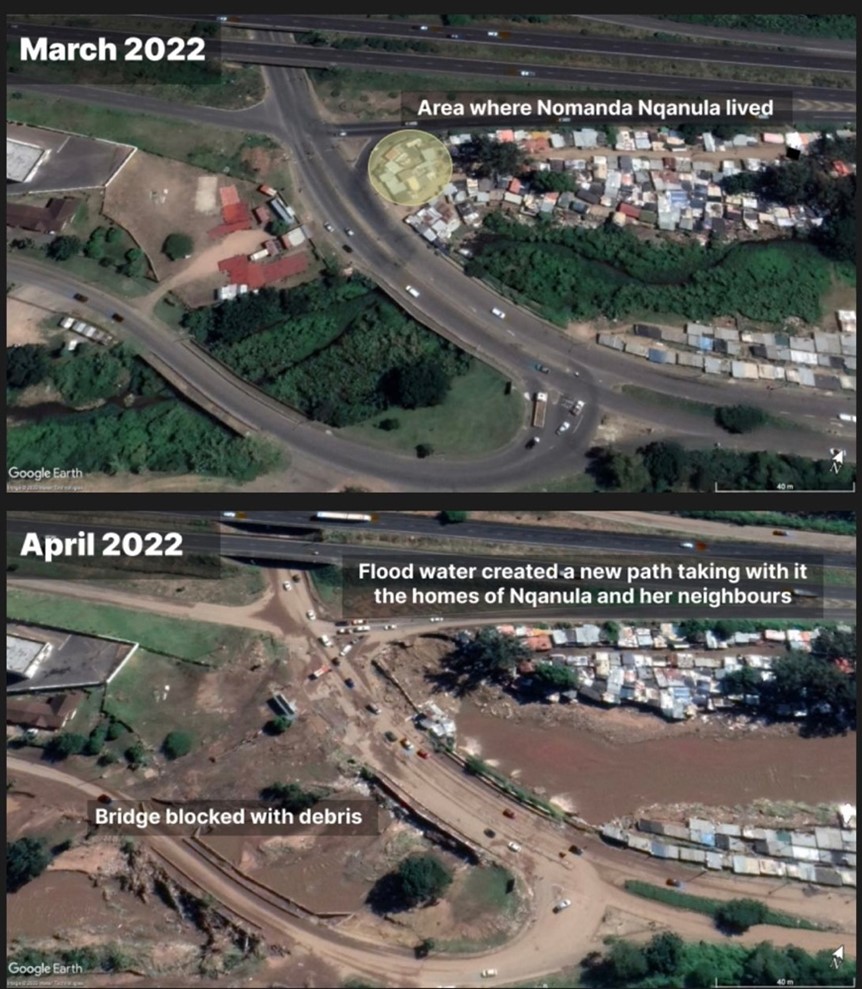
Source: The Outlier
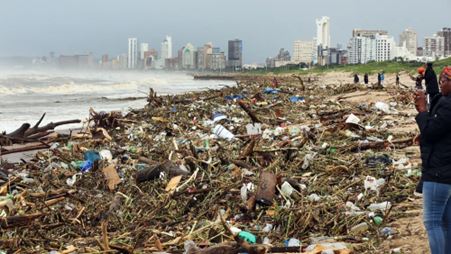
Cointained in the eThekwini Municipality’s 2025 budget, it reports that since 2009, the city implemented a programme to clear vegetation and debris along the 520km stretch of streams and rivers. It employs about 107 community organisations at the cost of about R50 million per annum to remove overgrown vegetation and debris in the rivers. Yet after more than 15 years of investment in this programme, almost every river and stream was overloaded with debris and overgrown vegetation which exacerbated the damage to local communities living nearby rivers and streams, as is shown in the above picture. Most of these rivers and streams lead into the Umgeni River and eventually into the Indian Ocean. Seen below is a picture of the massive debris field strewn along the Durban beachfront at the Umngeni River Mouth, after the floods in April 2022.
Source: The Outlier
Budgeting to
Flood-Proof Durban
Given the propensity and frequency of flooding in the city, there is no other choice but to ensure that urgent and drastic measures are adopted to ensure minimal loss of life and damage. Whilst it may not be possible to completely eradicate all potential damage, there is certainly much a city can do to mitigate against flood disasters and be better prepared for the next major flood. However, given the poor management of its existing expenditure programmes (stream cleaning programme), poor financial management and the high levels of expenditure on non-essential services, it doesn’t come as a surprise that the city is poorly prepared for future flooding incidents.
eThekwini Financial Status
In the most recent Budget speech, the Mayor of eThekwini reported a budget of R71 billion. (R64bn operating and R7bn capital budget)
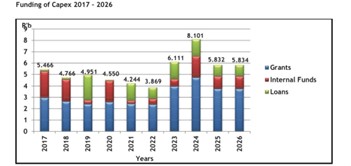
Of significant importance is the City’s declining ability to increase capital expenditure without having to rely on loans and grants. The table below reflects a growing reliance on grants and loans (blue and green bars) to fund capital expenditure and a decline of internal funds (red bar) invested towards capital expenditure. These expenditure patterns do not contribute towards the sustainable development of a major metro such as the eThekwini municipality.
Source: eThekwini Municipality medium term expenditure framework 2025/2025
Notwithstanding the unqualified reports that the city received, it struggles to use its finances in the most efficient and effective manner.
Poor financial management and weak oversight of programmes and projects results in poor service delivery in almost every department. This becomes more evident when assessing the state of municipal finances and the questionable management of public resources.
The table below highlights a sample of questionable expenditure patterns and financial management of the city over the years. The poor management of its resources and the lack of investment in flood prevention strategies are a major contributing factor to the levels of devastation that has been seen in eThekwini during recent incidents of flooding.
The table below indicates the critical state of city coffers and the manner in which its resources are managed. Much of these wasted funds could be used more effectively towards flood prevention strategies and to reduce the overall impact of flood disasters in the city.
|
Rand value
|
Details
|
|---|---|
|
R3.9 billion
|
Irregular expenditure grew from R732 million in 2020 to R3.9 billion in 2024. Repeat findings by the Auditor General revealed that most of this irregular expenditure relates to failure to adhere to proper tender and procurement process as well as lack of consequent management.
|
|
R35 billion
|
Outstanding debts owed to the city grew from R16bn in 2021 to R35 billion in 2024.
|
|
R3 billion
|
Water Loss - This year the city will spend about R5.7bn rand on bulk water purchases from Umgeni Water and resells this at a profit to its residents. Due to ageing infrastructure and lack of maintenance programmes, 58% of the water it purchases is lost through non-revenue water, most of which leaks into the ground. Similar amounts of wastage were reported over the last 5 years. This loss is recovered from consumers, so residents are essentially paying more than double the amount that they should be paying for water in the city.
|
|
R500 million
|
Smart Meters - The city embarked on a programme to curb water losses and procured about 70 000 smart water meters in order to monitor water usage in a more effective manner. A whistleblower recently revealed that the Head of Finance in the city was involved in the rigging of the tender and this is likely to take another few years before the project is implemented.
|
|
R160 million
|
Poverty Alleviation - eThekwini Municipality spends R162m on poverty alleviation projects, employing locals to clean verges, drains and assist with road maintenance. Yet almost every drain is waterlogged during heavy rains and overgrown verges are common place in the city.
|
|
R1.2 billion
|
Unfunded Mandates - The city spends R1.2bn every year on unfunded mandates which should have been funded by either the provincial or national government.
|
|
R597 million
|
Security Tenders - More than half a billion rands is spent every year on security tenders and the city has become famous for security tender irregularities. It spends R36 million a year on security to protect 28 councillors and a further R541 million on external security for only 5 departments. Whenever a pipe is being repaired anywhere in the city, contracted security guards are on the scene first, even in low risk areas.
|
|
R21 million
|
Tender Irregularity - R21 million was spent on an investigative services tender 3 years ago, and the Auditor General found that the services were never delivered. To date, not a single rand was recovered.
|
|
R118 million
|
Soup Kitchens - The city spends about R118m on soup kitchens using local community contractors. Attempts to reach some of the contractors often reach a dead end and very few people know where these soup kitchens are located.
|
|
R33 million
|
Food Parcels - 33 million rands a year is spent on handing out food parcels to senior citizens.
|
|
R24 million
|
Parties - 24 million rand will be spent in this financial year sponsoring music parties, picnics and fashion shows.
|
|
R43.9 billion
|
Total value of questionable expenditure and financial management which equates to more than half of the city’s annual budget.
|
Flood Prevention Programmes and Strategies
Flood prevention strategies are not a knew subject matter. Extensive research has been conducted globally using weather modelling and climate change research outcomes to better equip cities around the world to prepare effectively for flooding related incidents.
Perhaps the most extensive work done in this regard is by C40, a global network of 96 cities around the world who collaborate with each other to build better cities. Interestingly, Durban is also a member of the C40 network yet it has failed to implement the very basic recommendations provided by C40.
In a research paper and guide prepared for C40 by the Grundfos Foundation titled Effective Emergency Preparedness For Flooding & Drought, it identified 5 key components for effective emergency preparedness for cities. The figure below covers these components quite succinctly.
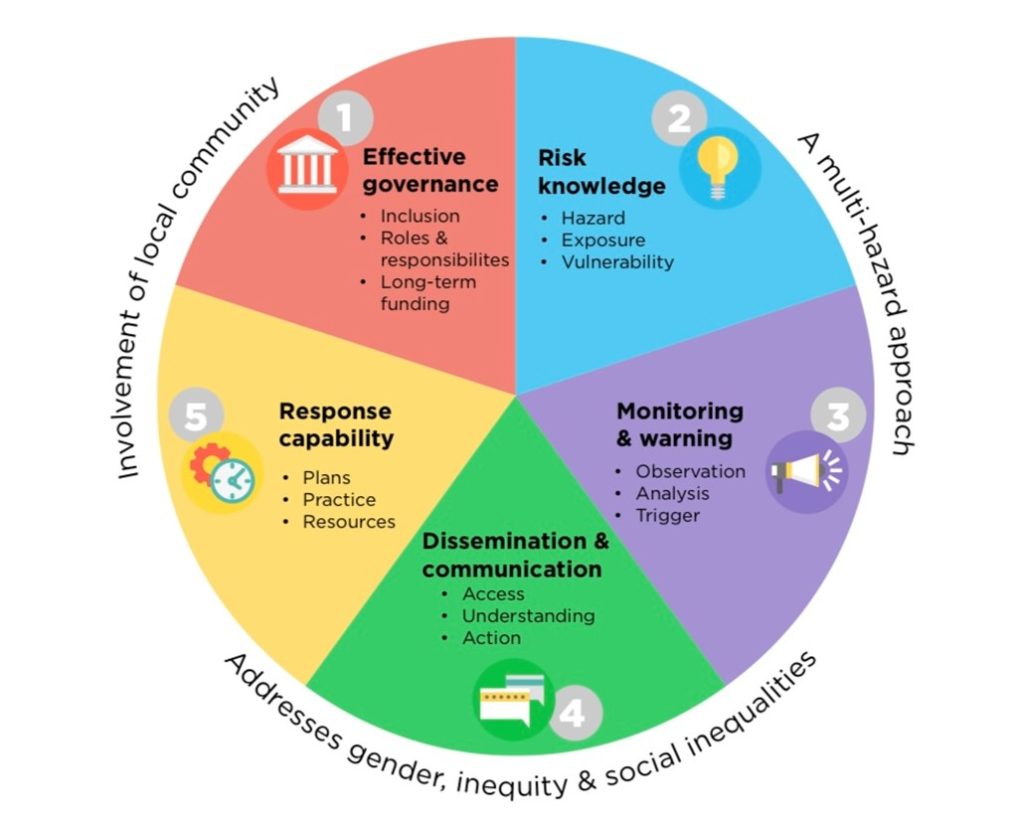
International best practise recognises that these five components are the most important facets of mitigating against the effects of major flood disasters.
Contained in this report, is a finding that 83% of cities worldwide have experienced extreme weather patterns and climate hazards. This finding should become an important pillar on which cities should design their respective development plans, given that the effects of climate change is a now a permanent feature of everyday life. Governments should therefore align their development programmes to mitigate against the effects of these changes. The C40 report estimates that there is a 1:35 ratio for investment and loss in respect of government funding initiatives towards climate change preparedness. In other words for every R1 spent on mitigation initiatives, R35 worth of losses is prevented. The opposite is then also true. The failure to invest in flood prevention strategies will results in losses, 35 times more than the initial value of public infrastructure and assets. It is evident therefore that “taking early action to protect the most vulnerable is proven to reduce climate-related loss and damage”
The initiatives proposed below, are based on international best practise to mitigate against climate-related incidents of flooding in the city of Durban.
1. Effective Governance
- Reduction in waste and non-essential expenditure and redirect resources towards flood prevention strategies.
- Increased investment towards upgrading, replacement and maintenance of storm water infrastructure.
- Relocation of informal dwelling in high risk areas – curb growth of new settlements.
- Increased investment in town planning programmes and enforce building by laws in accordance with flood prevention regulations.(flood line development)
- Increase investment in River and stream cleaning in a manner that is effective and properly monitored.
- Align the programmes of service delivery departments such as water, sanitation and solid waste departments in a manner that implements international best practise models for flood prevention.
- Rotational drain cleaning and storm water infrastructure upgrade eg City of Cape Town winter preparations.
- Immediately suspend all non-essential expenditure viz sponsorship of events that don’t contribute to economic development of the city. – potential saving R24 Million
- Reduce expenditure on unfunded mandates and engage the relevant government departs to include these programmes in their respective budgets.- potential saving R1.2.bn.
- Immediately begin a vigorous campaign to recover outstanding debts over a phased approach. – Potential impact +R20bn
- Review its poverty alleviation programme in a manner that contributes towards job creation projects instead of handouts. – Potential saving R162million
- Suspend the distribution of food parcels and review the programme in a manner that contributes towards skills development and job creation. Potential impact (unknown)
- Recover outstanding payments from service providers who have failed to deliver- Potential savings – in excess of R50m
- Immediately implement a water loss reduction strategy to include upgrading of ageing infrastructure – Potential saving of R10bn in the medium term
2. Risk Knowledge
Invest in flood modelling systems to identify flooding hotspots and implement focussed programmes.
Identify high risk informal settlements for urgent relocation programmes.
Conduct a full risk assessment of existing canals.
Identify streams and rivers that require canalization project implementation.
3. Monitoring and Warning
Increased investment in early warning systems through the use of advanced communication technology.
Develop partnerships with NGO’s and community based organisations to feed-in live updates during periods of high rainfall patterns.
Establish linkages with private sector such as insurance companies to fund flood mitigation programmes.
4. Dissemination and Communication
Appoint flood warning monitors in every informal settlement to disseminate information and warnings during high risk periods.
Develop formal communication channels (eg WhatsApp channels) with community based organisations for immediate dissemination of flood warnings.
Develop proactive evacuation plans for informal settlements in high risk areas.
Conduct active educational programmes with communities in high risk areas to prevent and mitigate loss and destruction during incidents of flooding.
5. Response Capability
Increase budget allocation to emergency services and disaster management departments.
Establish joint operation command centres at a metro wide and regional levels for faster response times to emergencies.
Develop partnership strategies with provincial and national government departments to enhance response strategies.
Establish private sector partnerships such as security companies, and private medical care facilities for faster emergency response during periods of high rainfall and flooding incidents.
Antonio Guterres
UN Secretary General
Conclusion
It is evident from the factual information provided in this report, that it is very possible to manage the city of Durban in way that builds resilience towards incidents of severe flooding. However, to achieve this object, it will require, reducing wastage, eradicating corruption, building more effective management and monitoring systems and most importantly, re-directing existing funding towards strategies and programmes that mitigate against damage to public infrastructure and the loss of lives.
The writer of this report served as a councillor on the eThekwini Municipality for several years and was a member of the Parliamentary Ad Hoc Committee on flood disasters in KZN. During the parliamentary committee’s visit to Durban, he conducted several inspections of damaged sites. Formal engagements were also held with the leadership of the eThekwini Municipality, government experts and affected residents at the time. The information contained in this report is based on a combination of researched reports, published papers, media articles and personal experience.